
Overview of Basic Lighting Materials
The development of modern lighting is inseparable from the evolution and innovation of basic lighting materials. From the initial traditional materials to the widely used new materials today, the scientific application of lighting materials has significantly improved the performance and lifespan of luminaires. These materials exhibit superior properties under different temperatures and operating conditions, serving as a crucial driving force for advancements in lighting technology.

▣ Material Classification
▣ Fillers and Sealing Materials
In conventional low-temperature regions (<140℃), traditional materials such as indigo resins, neoprene rubber, EPDM foam rubber, and injection-molded polyurethane foam are widely used. However, for high-temperature regions (>200℃), extruded, molded, or cut silicone resins are required. In recent years, injection-molded reaction methods have become the latest innovation, enabling seamless, high-quality seals. Traditional and new fillers are used in different temperature regions to provide mechanical connections and seals.
During the lamp's lifespan, lamp cap putty needs to provide a reliable mechanical connection between various coefficients of thermal expansion and different lamp materials. The material used to attach the metal lamp cap to the glass bulb is typically a mixture of approximately 90% marble powder filler with phenolic, natural, and silicone resins. For attaching the ceramic lamp cap to the fused silica lamp body, a higher-melting-point solder paste is required, its main component being a mixture of silica and inorganic binders such as sodium silicate.
▣ Gases The primary gases used in lamps, as components of air, are usually obtained through fractional distillation. These gases are used not only to control various physical and chemical processes but also to generate light. During lamp operation, the high-temperature environment significantly enhances the chemical reactivity of many lamp materials, potentially leading to severe damage to the lamp's structural materials. To avoid this, the lamp structure must be protected by controlling oxidation and corrosion. A common method is to use inert or non-reactive gases to maintain the working environment inside the lamp.
Physical processes such as evaporation and sputtering shorten the lifespan of critical components such as the filament and electrodes. However, when the lamp is filled with inert gas and the gas density is sufficiently high, the harmfulness of these processes is significantly reduced. While high-density krypton can be used in some incandescent lamps to reduce heat conduction and suppress tungsten filament evaporation, thus extending lamp life, argon is typically used as the filler gas in practical applications.
Nitrogen molecules have the ability to prevent the formation of destructive arcs between components at different potentials within the lamp; therefore, the filler gas for lamps is usually composed of nitrogen or a mixture of nitrogen and the inert gases argon and krypton. In gas discharge lamps, monomolecular gases such as argon, neon, and xenon are used as auxiliary gases for discharge initiation. Furthermore, metal halide gases also play a unique role in gas discharge light sources.
Due to the extremely high operating temperatures of the lamps, certain critical components within the lamp are highly sensitive to trace amounts of oxidizing and carbon-doped gases, including oxygen, carbon monoxide, carbon dioxide, hydrocarbons, and water vapor. In most lamps, the content of these harmful impurity gases is usually strictly controlled, allowed to be only a few parts per million of the total filler gas.
▣ Getter Materials
During bulb operation, components such as the filament and electrodes reach extremely high temperatures. These components are highly sensitive to surrounding gases and readily react with residual oxygen, water vapor, hydrogen, and hydrocarbons, thus affecting bulb performance. Therefore, measures must be taken to eliminate or reduce these residual gases. Getter materials remove residual gases from the bulb using metallic or non-metallic materials, maintaining bulb performance.
A getter is a material specifically designed to remove impurities from the bulb shell or tube after sealing. Getter materials are generally classified into two types: vaporization getter materials and volumetric getter materials. Vaporization getter materials are used after vacuum devices are sealed. They work by rapidly heating or instantaneously vaporizing an active metal, appearing as a thin deposit or film on selected components to eliminate gas. Volumetric getter materials, on the other hand, are often placed inside the bulb in the form of metal wires, structural components, or semi-loose deposits. They absorb gases when the temperature rises and remain effective throughout the bulb's lifespan.
Commonly used getter metals include barium, tantalum, titanium, niobium, zirconium, and their alloys. In addition, phosphorus, a non-metallic gas-eliminating agent, effectively removes trace amounts of oxygen and water vapor from the inert gas inside the bulb, and has therefore been widely used for a long time.
▣ Glass and Quartz Glass
Commercially produced glass can be divided into three main categories: sodium-calcium silicate, lead-alkali silicate, and borosilicate. Sodium-calcium silicate glass is the most commonly used in the lighting industry. The choice of glass type depends on temperature requirements, maintaining airtightness and electrical performance.
Lead-alkali silicate glass is mainly used to manufacture internal components for ordinary light bulbs and fluorescent tubes. For conventional spotlights and high-power discharge lamps with higher operating temperatures, borosilicate glass is required. Quartz glass has high transparency, excellent thermal shock resistance, and can withstand high-temperature environments, with operating temperatures up to 900 degrees Celsius.
Airtightness is a key indicator when selecting glass materials for lamps. The glass must have the property of stress-free sealing with metals to ensure the bulb's airtightness and long-term stability. Furthermore, the resistivity, dielectric constant, and dielectric loss of the glass must meet satisfactory standards to satisfy electrical performance requirements.
▣ Ceramic Materials
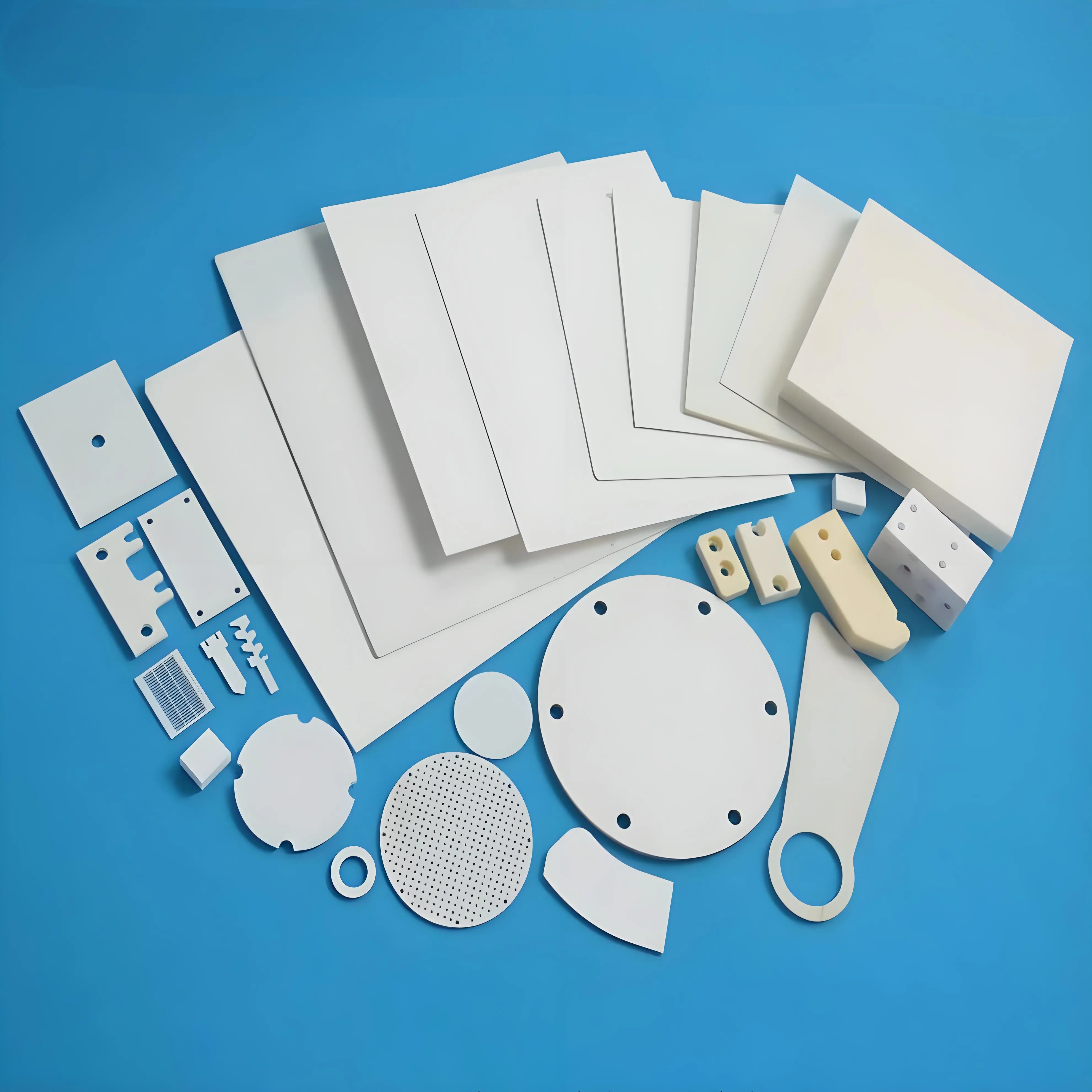
Under high temperature and high pressure environments, silica-containing glass is easily corroded by alkali metal vapors, thus requiring materials that can withstand chemical corrosion. Ceramics are used for high temperature and corrosion resistance, possessing high mechanical strength and thermal stability.
Polycrystalline semi-transparent alumina (PCA) tubes are a key component in the manufacture of high-pressure sodium lamps (HPS). Despite a wall thickness of only 1 mm, they achieve a total visible light transmittance of over 90%. Ordinary ceramics, due to their good mechanical strength, thermal shock resistance, and excellent electrical insulation over the operating temperature range, are often used to make lamp holders and lamp bases.
▣ Materials for Light Control
Reflectors are key components in light control, and they are divided into two types: regular reflection and specular reflection. Diffuse reflection is also an important reflection method. When selecting light control materials, we must comprehensively consider various factors, including the material's optical properties, strength, toughness, heat resistance, and ultraviolet radiation resistance.
Infrared reflective films are a key light control material that significantly improves the efficiency of incandescent lamps by reflecting infrared energy back to the filament. Multilayer oxide overlay technology is also widely used in the manufacture of infrared reflective films, applied to the surface of halogen filament lamp housings via chemical vapor deposition. Simultaneously, multilayer interference filter film technology is also used to alter the color of light. The selection of reflective materials balances optical, mechanical, and thermal properties to enhance lamp efficiency.