

Choosing the right light bulb can be a challenge. Careful selection of bulb size is necessary, as even slight differences in screw thread size can lead to incompatibility. Understanding different bulb screw thread types, such as E26, E27, E14, and E12, helps ensure the correct bulb is selected for your lighting fixture.
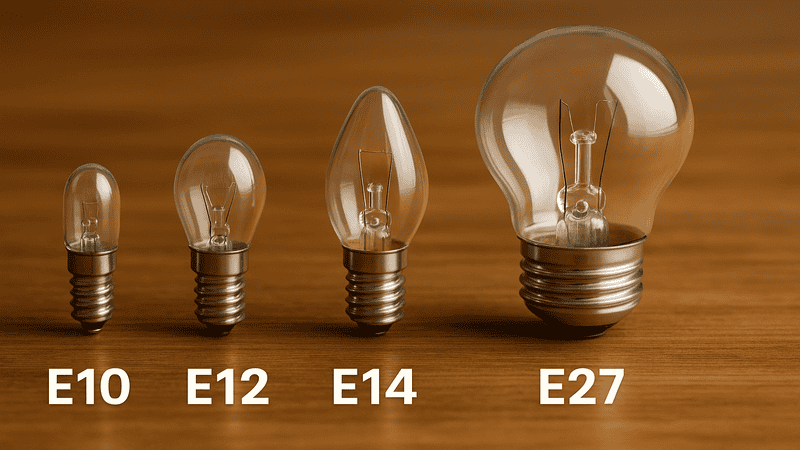
In this guide, we'll explain the sizes of E14 bulbs and other screw thread bulbs to help you make an informed choice. Ready to delve deeper? Let's get started!
What does the "E" in bulb model codes stand for?
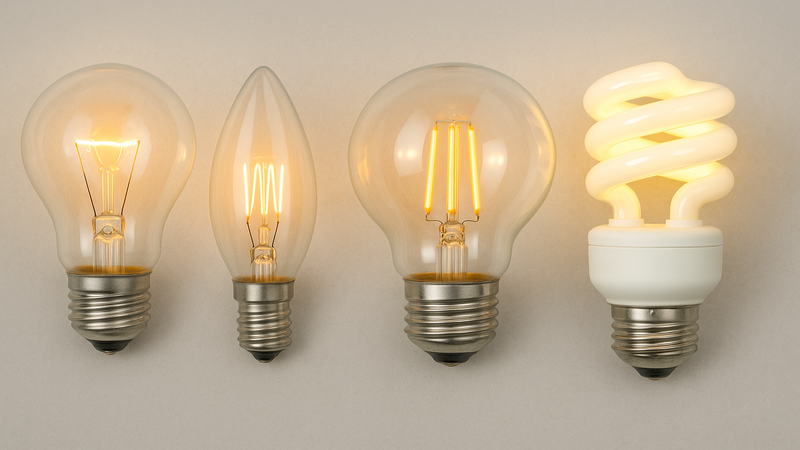
Different Edison screw thread bulbs are suitable for different lighting fixtures
You may have noticed that most bulb codes include the letter "E". Have you ever wondered what this letter represents? Actually, "E" stands for Edison screw thread bulb, named after Thomas Edison.
The Edison screw thread is a standard bulb screw thread. The number after the "E" in the bulb model code indicates the diameter of the bulb screw thread, in millimeters. For example, the Edison screw thread diameter of an E14 bulb is 14 millimeters.
Common bulb socket types include miniature E10, candlestick E12, miniature Edison screw E14, and standard E26 or E27 socket sizes, which are used in most household bulb sockets.
It is important to note that the socket diameter is always larger than the screw thread to ensure the bulb can be installed smoothly and securely. The table below compares the most common screw thread sizes and their socket and nut diameters:
Nut Name Holder Diameter Actual Nut Diameter
E10 10 mm 9.3 mm
E12 12 mm 11.5 mm
E14 14 mm 13.5 mm
E27 27 mm 26 mm
E10 Bulb: Miniature Edison Screw (MES)
Commonly used in commercial and residential environments
The E10 bulb is a miniature Edison screw bulb with a diameter of 9.3 mm. This bulb is designed to be installed in a 10 mm socket.
These bulbs are small in size and ideal for vintage lighting fixtures such as old-fashioned chandeliers, toy trains, model lamps, and indicator panels. Due to their compact size and decorative appearance, they are often used to enhance the overall aesthetics of a space.
However, they are not typically used in general household lighting fixtures, but are more popular with hobbyists and DIY enthusiasts for miniature lighting projects.
E12 Bulbs: American Candlestick Base
E14 bulb bases are slightly larger than E12 bases.
E12 bulbs, with an 11.5mm diameter Edison screw thread, can be installed in 12mm bulb holders. This size of holder is known as an American candlestick base and is common in the United States, especially in vintage candlestick-style fixtures such as chandeliers and decorative wall lamps.
In terms of bulb base size, E12 bases are smaller than the E26 bases used in standard lighting fixtures. Comparisons between E12 and E26 bulbs are very common for homeowners looking to replace or upgrade their lighting.
In Europe and the UK, E12 bulbs are not common and are not readily available in local markets. However, you can purchase them through online bulb retailers.
E14 Bulbs: Miniature Edison Screw Socket (SES)
Common Shapes of E14 Bulbs
E14 refers to a miniature Edison Screw Socket (SES) bulb with a diameter of 13.5 mm, mounted in a 14 mm socket. These bulbs are widely used in European-style lighting fixtures.
E14 bulbs are commonly found in residential lighting. These bulbs are ideal for smaller or more decorative fixtures such as wall lamps, chandeliers, and table lamps.
E14 bulbs come in various shapes, such as candle-shaped, reflector-shaped, and decorative filament shapes, making them widely used in stylish lighting fixtures.
When comparing E12 and E14 bulbs, it's important to know that these two types are interchangeable. However, this requires an adapter.
In contrast, the E26 bulb, commonly used in the United States, has a much larger socket and is typically used in standard lighting fixtures. This size difference highlights the importance of checking the type of socket for your light fixture before purchasing.
E27 Bulbs: Standard Edison screw base, equivalent to an E26 socket.
E14 and E27 bulbs are commonly used in general lighting fixtures.
The E27 bulb has a 26mm screw diameter, perfectly fitting a 27mm socket. This type of bulb is not used in chandeliers but is common in other floor lamps, ceiling lights, and some commercial lighting fixtures.
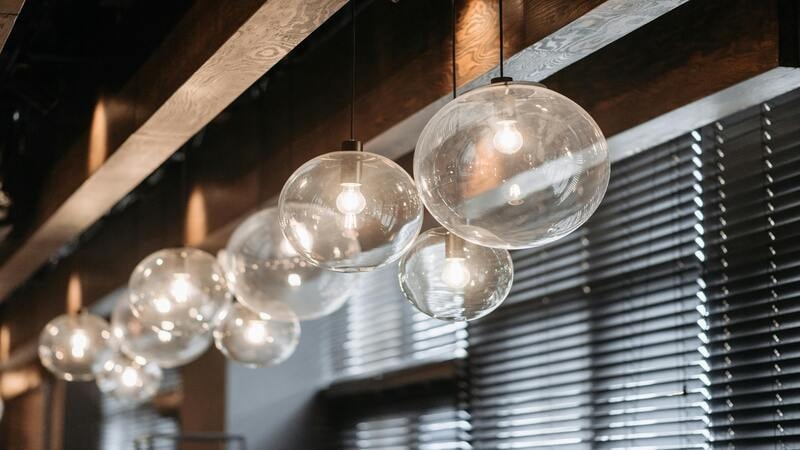
In North America, the standard is the E26 socket. While many buyers search for "E26 vs E27," it's important to note that these two sockets are functionally interchangeable, as their size difference is minimal and they are practically identical.
When comparing E14 and E27 bulbs, people often feel confused about which bulb is suitable for decorative lighting and which for general lighting.
The answer is simple: use E14 bulbs for small decorative lighting fixtures, and E27 bulbs for general lighting fixtures.
The A19 is a bulb shape (classic pear shape) that typically uses an E26 socket (screw portion). This combination is so common in American households that people often confuse the two names, leading to frequent comparisons of "A19" and "E26".
Light Bulb Base Side-by-Side Comparison Chart: E10 vs E12 vs E14 vs E27
Below is a side-by-side comparison of different light bulb base sizes to help you choose the option that best suits your needs:
Features: E10 E12 E14 E27
Cap Diameter: 9.3mm 11.5mm 13.5mm 26mm
Base Size: 10mm 12mm 14mm 27mm
Common Applications: Model trains, panels, toys, American candlesticks, nightlights, chandeliers, table lamps, oven and wall lamps, ceiling lights, pendant lights and large light fixtures
Region: Global, Primarily from the USA, Europe/UK, Global
Availability: Low (Specialist Supplier), Medium (Online Retailer), High (Available Stock), High (Most Standard Bulbs)
Interchangeable: No, With E14 Adapter, With E12 Adapter, No
Also known as MES (Miniature Edison Screw), Candlestick/Intermediate Screw, SES (Small Edison Screw) ES (Edison Spiral)
This chart helps anyone understand standard bulb socket types, bulb receptacle types, and comparisons of bulb sockets in different regions.
Are E10, E12, and E14 bulbs interchangeable?
E10 sockets are ideal for decorative lighting fixtures.
At first glance, E10, E12, and E14 bulbs may look the same; however, technically they are not. This means that these bulbs are not interchangeable without an adapter.
When comparing E10 and E12 bulbs, note that E10 bulbs are designed for micro-lighting and operate at lower voltages (typically 12V or 24V). Using an E10 bulb in a high-voltage bulb socket will significantly reduce bulb performance and may pose a risk of electric shock.
Therefore, it is not recommended to directly interchange E10 and E12/E14 bulbs, as this poses a serious voltage risk.
E12 and E14 bulbs are the same size (similar in appearance and function) and are usually interchangeable with an adapter. When using interchangeable bulbs, always check the voltage, shape, and installation depth of the light fixture to avoid problems.
Using an adapter may increase the height of the bulb, so ensure there is sufficient space in the light fixture or shade. Using an incompatible bulb can pose a fire hazard. Therefore, when replacing a bulb, always carefully check the bulb model and the fixture's socket size. Safety is always the top priority.
To ensure correct installation, if you are unsure which bulb socket type your light fixture supports, please refer to the light fixture manual or the bulb socket specification table to confirm compatibility.
How to accurately measure a bulb socket?
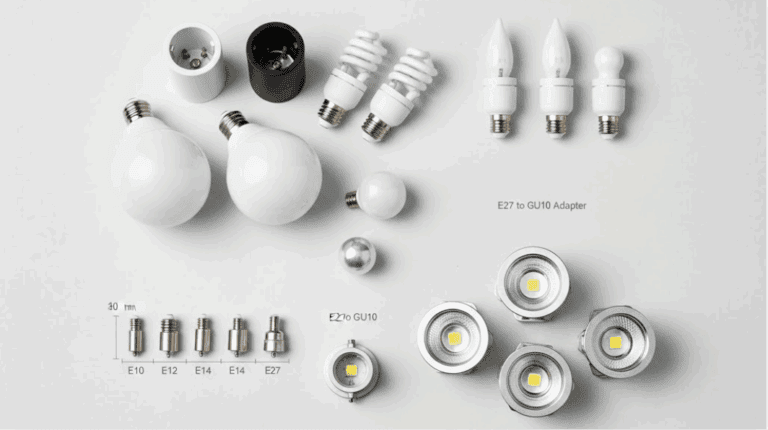
Here, Risun's various light sources and matching sockets are elegantly displayed in a professional catalog layout.
To ensure you select the right bulb type for your indoor or outdoor lighting fixtures, accurately measuring the bulb socket size is crucial. To easily calculate the bulb socket size, follow these steps:
1. Measure the inner diameter of the socket.
Measure the width of the inner diameter of the socket using a ruler or tape measure. By measuring the socket, you can determine the bulb model that will fit. For example, if the bulb socket is 14 mm wide, the appropriate bulb model is E14.
2. Measure the width of the bulb socket.
Don't just measure the threads on the bulb; measure the jack inside the bulb. Because the threads are smaller than the socket, directly measuring the threads is not a good idea.
Also, this code refers to the socket diameter, not the thread diameter. Accurately measuring the diameter of the widest part of the bulb socket is an effective way to determine the correct model.
To identify an E26 socket, look for a socket with a thread width of approximately 26 mm. This size makes it the standard bulb socket size in the United States.
3. Check the instruction manual for your existing bulb or light fixture.
It is recommended that you check the bulb model number listed on the product packaging (or, when shopping online, check the product page) to ensure you choose the correct bulb type. This is the simplest and most accurate method.
How to Choose the Right Bulb: Final Tip
A table listing which bulbs to choose along with product images.
When you are shopping for the right bulb in the market, the following tips can help you:
For small projects, choose an E10 bulb.
For American-style candlestick lamps, choose E12 bulbs.
For small indoor lighting fixtures, especially in the UK and Europe, choose E14 bulbs.
For general lighting, floor lamps, ceiling lights, and household use, choose E27 bulbs or E26 base bulbs.