

Commercial property owners can now easily retrofit their buildings, saving more energy and costs and increasing their net income in the process, thanks to numerous government-supported financial incentives for energy infrastructure projects.
The world has experienced numerous extreme weather events over the past three decades. Given the severity of the situation, nearly 200 countries, along with the European Union, signed the Paris Agreement in 2015 to address climate change. This agreement calls for reducing global CO2 emissions to net zero by 2050.

Even in the United States, reducing carbon emissions has become a national priority in recent years. Many government policies today focus on renewable energy, energy-efficient retrofits, building electrification, sustainable manufacturing, and resilient land use. This includes the Inflation Suppression Act of 2022, considered the largest climate legislation in U.S. history.
New York City is a prime example of how boroughs are developing their own policies. The city's No. 97 local law will take effect in 2024. Under this law, buildings with a floor area exceeding 25,000 square feet will be subject to carbon emission limits, with penalties for exceeding these limits. This move aims to optimize energy efficiency, thereby reducing carbon emissions and related costs.
The growing popularity of zero-emission electric vehicles (EVs) has led to a significant increase in the prevalence of charging stations in commercial buildings. In the future, we may see more commercial buildings installing EV charging stations due to government mandates (as with public buildings), or as a source of revenue or additional amenities.
Furthermore, various lighting subsidy programs are available for homeowners, businesses, and nonprofits. These incentives are tailored to each state's unique energy environment and are provided by local governments, regional energy providers, and utility companies. As a result, LED lights have become a sought-after commodity for those looking to maximize energy tax benefits, particularly in states like Massachusetts and New Hampshire.
The value of energy-efficient lighting and control systems has always been there. However, the new development is that in a decarbonized world, the real benefits of energy conservation are more likely to be recognized, paving the way for more sustainable (and therefore more cost-effective) projects in the long run.
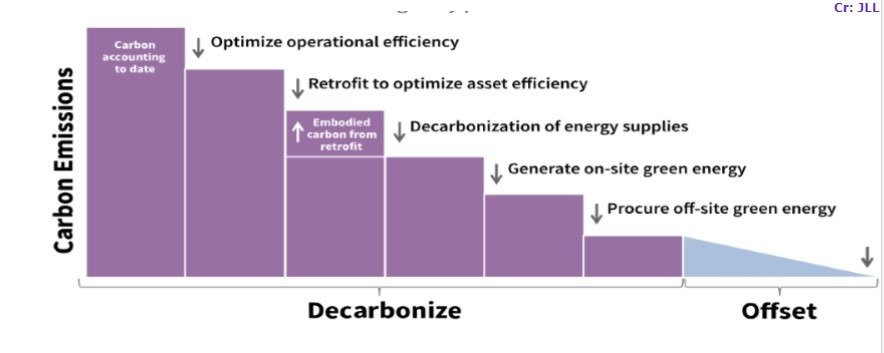
In its latest research, real estate services firm JLL has released its asset decarbonization roadmap, exploring three levels of retrofitting—from lighting upgrades and performance optimization to in-depth whole-building renovations.
Decarbonization Pathway
According to this, northern countries globally, including the US, Canada, and the EU, need to increase their building retrofitting rates from 1% to at least 3% annually to fully offset carbon emissions. In fact, companies that are the first to adopt net-zero emission buildings will benefit significantly from this increasing competition, as they can attract high-quality tenants and charge higher rents, which will increase net operating income and deliver value beyond simple ROI.
Finally, as JLL's research concludes, "Retrofitting existing buildings is the fastest and most cost-effective way to accelerate the decarbonization of the built environment." The study emphasizes that using LED lighting, strategically placing sensors, and adopting digital (networked) lighting controls not only helps with energy management but also improves occupant comfort.
