
New Trends in Global Nighttime Light: Increased Alternation Between Bright and Dark Areas, No Longer a One-Way Continuous Brightening
Even with proactive reductions in nighttime lighting in some key areas, the overall global nighttime light intensity is still on an upward trend.
For a long time, astronomers and dark sky conservationists have lamented the reality that the brilliant starry sky we see on Earth today is no longer what it once was. Stepping out of densely populated urban areas and looking up, we find that the once magnificent and vast night sky, which guided ancient people, is now just a hazy gray halo in most parts of the world. The changing lights at night also reflect the stories of human societal development. NASA, through satellite observations, has revealed a new pattern of change behind nighttime light.
A recent groundbreaking study published in *Nature* analyzed nearly a decade of daily satellite imagery from NASA's "Black Marble" project, overturning decades of long-held belief that global nighttime lighting would only brighten steadily and continuously year by year. The reality is far more complex than imagined. Currently, the phenomena of brightening and dimming are occurring simultaneously worldwide, even within the same country, with the pace of these changes accelerating.
Overall Data: Global Light Intensity Increases, with Wide Range of Fluctuations
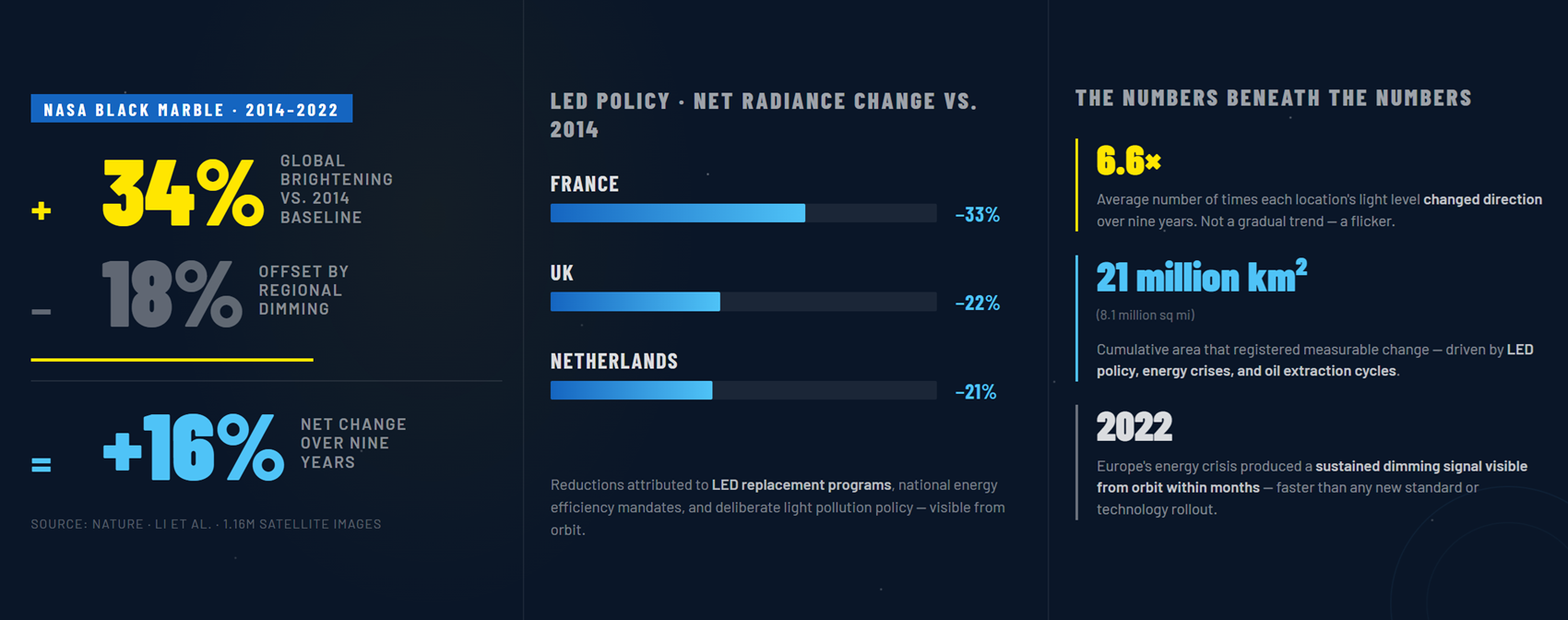
This study, led by scholars from the University of Connecticut in collaboration with NASA's Goddard Space Flight Center, the University of Maryland, Yale University, Cornell University, and research institutions across Eurasia, analyzed 1.16 million satellite images taken between 2014 and 2022. Key findings include: based on 2014 data, global nighttime light intensity increased by 34% overall; however, dimming in various regions offset this 18% increase, resulting in a net increase of 16% in global nighttime illumination over nine years.
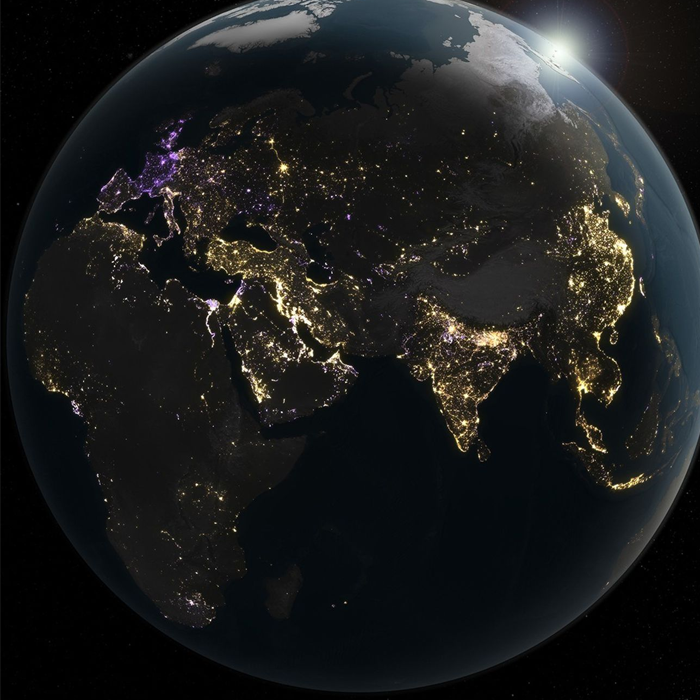
Beyond the data, the dynamic changes in light intensity are even more noteworthy. Statistics show that during the study period, all areas experiencing light changes saw an average of 6.6 shifts between light and dark, affecting a total land area exceeding 21 million square kilometers. The Earth is no longer a slowly illuminating planet, but rather resembles a constantly flickering light.
Europe and America: Policy and Technology Drive the Decline in Light Intensity, with Significant Regional Differences
The widespread adoption of LED lighting and the implementation of related regulations have left clear imprints on satellite imagery, making the changes in light intensity in Europe and America a key reference for the lighting industry.
Many European countries have seen a significant decline in nighttime light intensity: compared to 2014 data, France saw a 33% decrease in total nighttime light radiation, the UK a 22% decrease, and the Netherlands a 21% decrease. The reasons for this include the widespread replacement of lighting fixtures with LEDs in various countries, the implementation of mandatory energy efficiency standards by the EU and other countries, and the implementation of policies related to light pollution control—multiple factors have jointly driven the reduction in nighttime light intensity.
For a long time, the industry has continuously argued for the economic value and environmental advantages of LED lighting fixtures in public buildings and municipal settings, with most conclusions relying on financial statements, electricity subsidies, and cost models. Now, satellite observation data directly demonstrates that lighting upgrades have indeed resulted in a quantifiable decrease in nighttime brightness across countries.
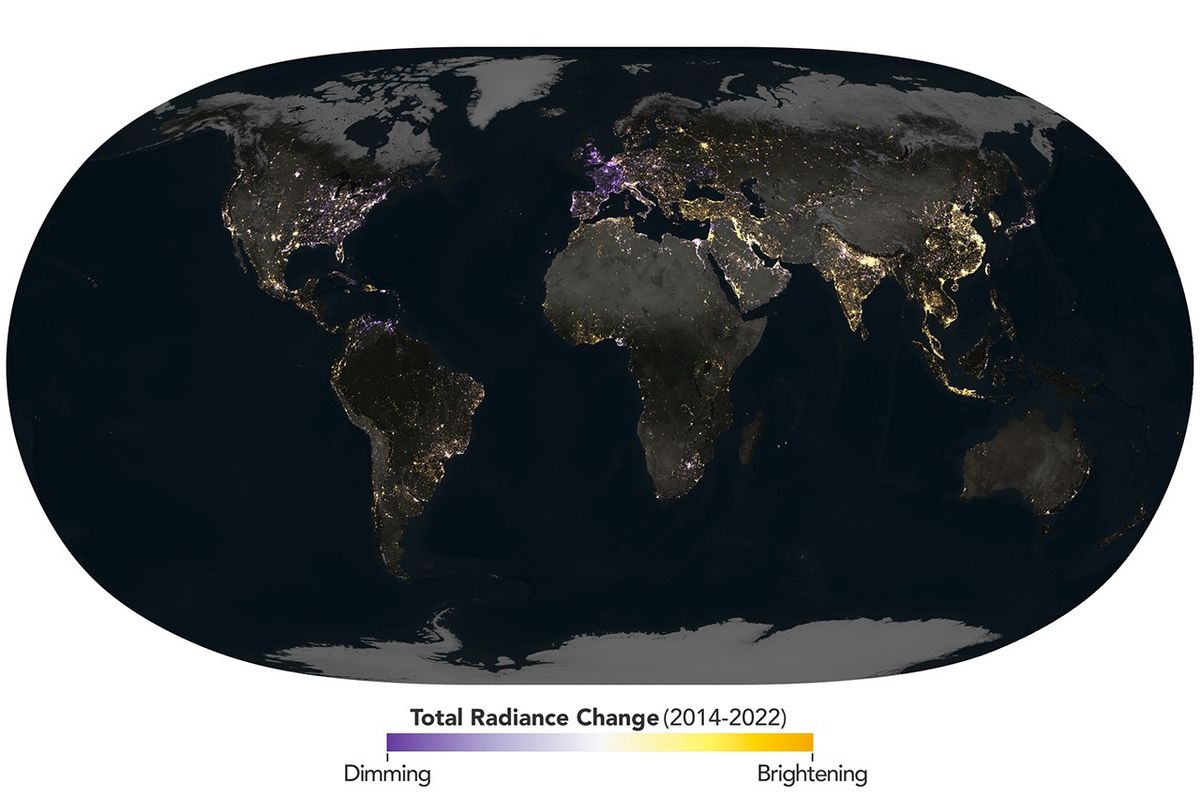
The changes in light intensity in the United States, however, show a distinct regional differentiation. West Coast cities are experiencing a sustained increase in light intensity, aligning with the trends of population growth and urban expansion in coastal cities. Meanwhile, light levels have dimmed across most of the East Coast and parts of the Midwest, primarily due to population loss in older urban areas, the decline of traditional manufacturing, and the widespread adoption of energy-efficient lighting. The central oil and gas producing regions exhibit distinct characteristics: the Permian Basin in Texas and the Bakken Shale in North Dakota experience surges in light intensity during oil and gas extraction booms, followed by a decrease in light intensity once extraction activity cools down. This fluctuation is highly correlated with the progress of oil and gas extraction and is not solely influenced by international oil prices.
Unexpected Events: Energy Crisis and the Pandemic as Drivers of Short-Term Light Intensity Fluctuations
The 2022 European energy crisis served as a natural social observation experiment. Affected by regional conflicts, energy supplies across Europe were strained, and satellite imagery revealed a continuous decline in nighttime light levels in many Western European countries starting that year, with France, Belgium, Poland, and the Netherlands showing particularly pronounced reductions.
Daily satellite imagery can capture details that annual summary data cannot show: after European countries implemented energy-saving measures, nighttime light intensity almost immediately declined. Within just a few months, Europe achieved a large-scale and significant reduction in nighttime lighting. This change was not driven by new technologies or regulations, but rather by the prohibitive force of high energy costs.
The COVID-19 pandemic has also left its mark on the global light landscape. Starting in early 2020, global nighttime light dimmed overall, with Asia showing the most pronounced effect—it was also the first region to implement strict epidemic prevention and control measures. Whether in Chinese industrial parks, Indian industrial zones, or commercial hubs across continents, nighttime lights dimmed synchronously. Daily video footage precisely recorded this change, something monthly statistics cannot achieve.
Asia and Africa: Continued Expansion of Lighting, Different Development Characteristics
Asia is the region with the most significant increase in nighttime light globally. China and India have seen the highest increases in overall light radiation, while the area affected by changes in light intensity in Africa far exceeds that of other continents.
The changes in light intensity in Chinese cities are highly representative: During urban redevelopment and demolition phases, there are short periods of reduced light, while the intensity quickly rebounds after the completion of new buildings and high-rise residential buildings. This alternating pattern of light and darkness reflects the speed of high-density urban renewal and reconstruction more directly than conventional economic indicators.
India's light growth is concentrated in the southern region, deeply linked to the local rural power grid expansion project. This change is driven by infrastructure construction and coordinated by the government, with the core goal of achieving universal electricity coverage, fundamentally different from the expansion of commercial lighting.
Industry Reference: Lighting Changes Reveal Market and Development Trends
This lighting monitoring data clearly outlines the pace of global electrification and the effectiveness of energy efficiency policies. It also marks regions experiencing fluctuations in electricity usage due to economic turmoil and industrial shifts, providing highly valuable reference for the entire industry chain. Whether it's lighting manufacturers expanding into overseas markets, distributors developing inventory plans, or service companies planning energy projects, all can glean strategic information from it.
The research summarizes clear patterns: regions with a long-term, steady decline in light intensity are mostly high-income economies. These regions have unified energy policies, and energy-saving lighting systems such as LEDs are well-developed. Conversely, regions with dramatic fluctuations in light intensity are generally concentrated in industrial areas, politically unstable regions, or rapidly expanding cities. Lighting fluctuations are closely related to local policy trends, financial investment, and social stability.
The magnitude of global light pollution continues to increase, with approximately 12,875 square kilometers of new areas experiencing dimming each year. In this period of transition, the global lighting landscape is rapidly evolving in a more diversified direction. For the global market, whether the European model of reducing lighting consumption through policy can be replicated and implemented in regions where energy efficiency regulations are not yet uniform has become a new challenge that the industry needs to explore.