

Metal halide perovskite nanocrystals have become ideal candidate materials for display technology due to their excellent optoelectronic properties. However, the weak coordination and long-chain structure of traditional ligands (such as oleic acid/oleylamine) lead to severe surface defects and limited carrier transport, restricting the improvement of perovskite light-emitting diode (PeLED) performance. To address this issue, the team led by Rongjun Xie from the School of Materials Science and Engineering at Xiamen University published a research paper entitled "Citrate Ligand Improves Luminous Efficiency of Green Perovskite Light-Emitting Diodes" in the *Journal of Luminescence*. The research team developed a short-chain, strongly chelating citric acid (CA) ligand that forms multiple coordination bonds and hydrogen bonds with the nanocrystal surface through its carboxylic acid group (-COOH) and hydroxyl group (-OH), achieving efficient passivation of surface defects in CsPbBr3 nanocrystals. The green perovskite light-emitting diode constructed based on this strategy achieved a peak external quantum efficiency (EQE) of 13.58%, providing a low-cost and efficient new solution for perovskite surface manipulation.
Ligand Interaction Mechanism
The research team innovatively selected citric acid as the ligand, introducing it into the CsPbBr3 perovskite nanocrystal system through a post-synthetic ligand exchange process. As a multidentate chelating ligand, citric acid's carboxylic acid and hydroxyl groups can stably bind to the CsPbBr3 surface through a dual interaction of bidentate coordination and hydrogen bonding. Density functional theory (DFT) calculations showed that the adsorption energy of the citric acid ligand reached -0.39 eV, significantly higher than the -0.26 eV of the oleic acid/oleylamine ligand, thermodynamically demonstrating its stronger surface binding ability. Fourier transform infrared spectroscopy and X-ray photoelectron spectroscopy further verified the formation of coordination bonds and hydrogen bonds, achieving efficient passivation of surface defects in the perovskite nanocrystals.
Figure 1: Interaction mechanism between CsPbBr3 nanocrystals and surface ligands
Multiple optimizations of nanocrystal optical properties
The modification with citric acid ligands comprehensively enhances the morphology and optical properties of CsPbBr3 perovskite nanocrystals. Morphologically, the modified CsPbBr3 nanocrystals retain their typical cubic phase, with a more uniform average size and significantly improved size distribution concentration, laying a structural foundation for enhanced optical performance.
In terms of optical performance, the modified nanocrystals exhibit excellent characteristics. Their emission peak stabilizes at 513 nm, with the full width at half maximum (FWHM) narrowing to 19.7 nm; the photoluminescence quantum efficiency (PLQY) increases significantly from 67.1% to 95.5%, and the nonradiative recombination rate decreases from 68.5 μs−1 to 5.4 μs−1, demonstrating significant defect passivation. Meanwhile, the citric acid ligand also improved the thermal stability of the material. Even at 100℃, the nanocrystals maintained a high initial fluorescence intensity, and the exciton binding energy was increased to 145.3 meV. This enhanced exciton binding effect ensured that the system maintained the exciton-dominated recombination pathway under high-temperature conditions, thus achieving a synergistic improvement in thermal stability and luminescence efficiency.
Figure 2: Morphology and optical properties of CsPbBr3 nanocrystals
Green perovskite light-emitting diode efficiency significantly improved
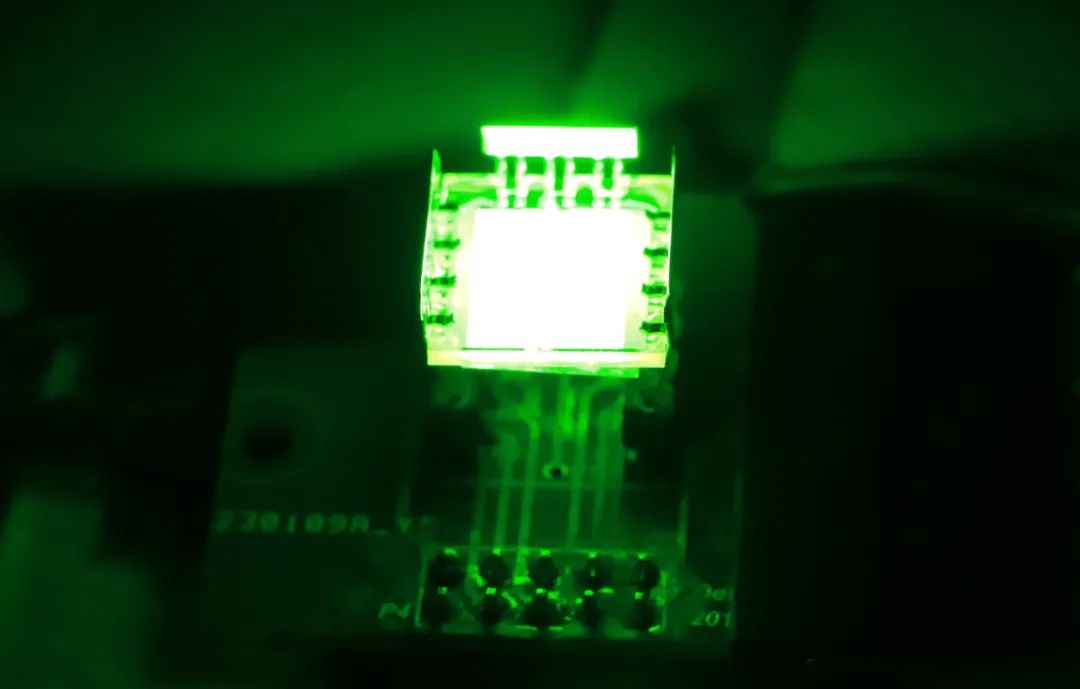
Based on citric acid-modified CsPbBr3 nanocrystals, the research team constructed a green perovskite light-emitting diode with an ITO/NiOx/Poly−TPD/CsPbBr3/TPBi/LiF/Al structure, achieving a significant improvement in the device's electroluminescence performance. The device exhibits an electroluminescence peak at 517 nm and CIE color coordinates of (0.099, 0.755), far exceeding the green light standard of the National Television Systems Committee (NTSC) color gamut, demonstrating excellent color purity. Peak brightness is increased to 1208 cd/m², and the peak external quantum efficiency (EQE) reaches 13.58%, 2.9 times that of conventional systems. Peak current efficiency is also improved to 42.93 cd/A. This performance improvement is attributed to the effective passivation of defects through surface ligand engineering, the modulation of carrier recombination pathways, and the optimization of their transport balance.
