

Foreign media reports that a research team at the Hong Kong University of Science and Technology (Guangzhou) has recently developed a novel Micro LED transfer process. This process is based on a dynamically programmable transfer head that utilizes localized heating to control the viscosity of the polymer.
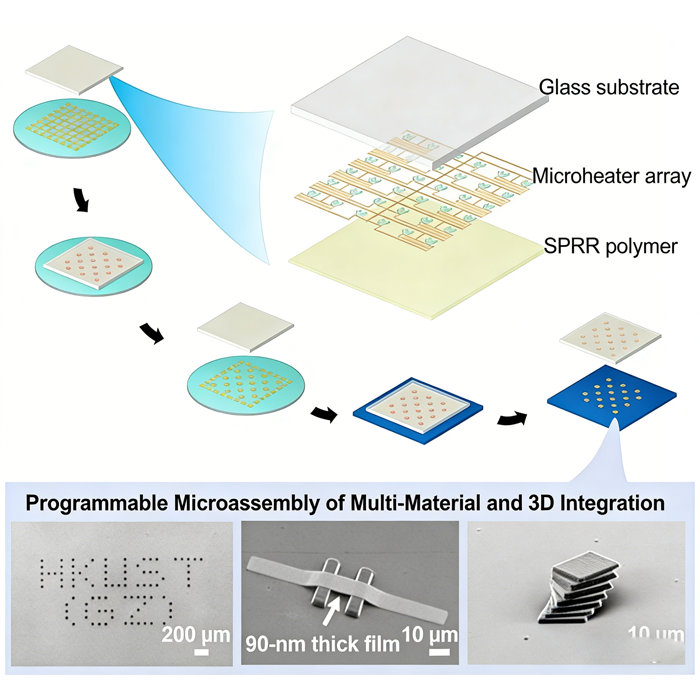
Researchers stated that this new tool can selectively process devices with various geometries, solving a key problem in the construction of complex microsystems. The research team demonstrated that the transfer system can selectively sort and transfer normally functioning Micro LEDs measuring 45 × 25 micrometers, arranging them into customized layouts without degrading their performance.
During the research, the researchers successfully transferred semiconductor chips, 90-nanometer-thick copper films, and 50-micrometer-diameter spherical polystyrene microspheres. The placement accuracy of these components was extremely high, with a positional offset of less than 0.7 micrometers and a rotational error of less than 0.04 radians.
To construct this transfer system, the research team formulated a special polymer that undergoes a rapid physical transformation at 44 degrees Celsius, changing from a rigid plastic state to a rubber state. The research team coated this polymer onto an array of independently controllable microheaters.
During the transfer process, the team pressed a stamp onto the element array, activating specific heaters that melted a target area of 50 micrometers on the polymer within approximately 60 milliseconds, allowing it to adhere to the selected chip. The polymer then naturally cooled and hardened within about 40 milliseconds, physically locking the chip in place. When the element needed to be moved to a new location, the heaters were triggered again to soften the polymer and release the chip. This temperature-driven mechanism provides a pick-and-release adhesion strength ratio exceeding 190:1.
Currently, the research team is investigating how to scale up the microheater array. This presents a challenge: densely packed heaters can lead to thermal crosstalk, where heat leaks to adjacent pixels. To address this, the researchers plan to use thinner polymer layers and introduce active matrix driving circuitry, similar to the architecture used in commercial flat-panel TVs, to manage large-scale arrays without excessively complex wiring.
Currently, the research team is investigating how to scale up the microheater array. This presents a challenge: densely packed heaters can lead to thermal crosstalk, where heat leaks to adjacent pixels. To address this, the researchers plan to use thinner polymer layers and introduce active matrix driving circuitry, similar to the architecture used in commercial flat-panel TVs, to manage large-scale arrays without excessively complex wiring.
