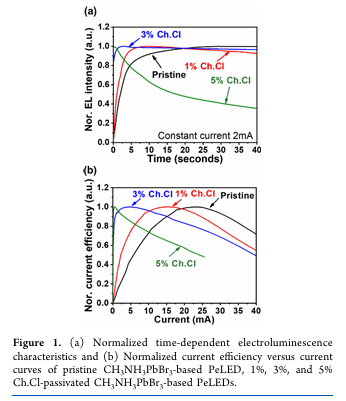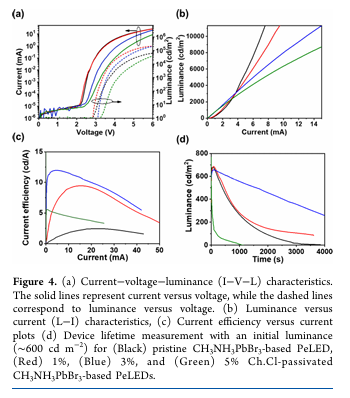

Organic-inorganic hybrid perovskite semiconductors have attracted much attention due to their excellent optoelectronic properties and are widely used in solar cells, photoelectrochemical cells, lasers, and light-emitting diodes (LEDs). Among these, perovskite-based LEDs (especially those using CH₃NH₃PbBr₃) have become a highly promising research area over the past decade. However, trapped states (especially those at interfaces) severely limit the performance and stability of perovskite LEDs. These energy-localized states within the band gap trap and release charge carriers, thereby reducing carrier mobility, increasing nonradiative recombination, and leading to a decrease in device efficiency. Trapped states in perovskite LEDs mainly originate from grain boundaries, intrinsic defects, and interface interactions. For example, specific point defects such as halogen vacancies and A-site vacancies, lead-halogen antisites, and halogen interstices can cause nonradiative losses. Halogen vacancies form positively charged sites, introducing defect states into the band gap, thereby trapping electrons and neutralizing holes, leading to trap-assisted electron-hole recombination, which significantly reduces device efficiency.
Wu et al. previously provided direct evidence for such traps in methylammonium lead iodide perovskite thin films using ultraviolet photoelectron spectroscopy. Conversely, excessive halogens in the environment may lead to the formation of halogen-rich surface layers, resulting in a self-passivation effect, promoting exciton generation, and increasing the radiative recombination rate. Traps-assisted nonradiative recombination is a major factor leading to luminous efficiency loss, especially at low carrier densities. In addition to promoting recombination, trapped states may also become channels for ion migration, further exacerbating device performance degradation. Another major problem is the imbalance of carrier injection in perovskite light-emitting diodes, leading to carrier accumulation at the interface, triggering nonradiative recombination and significant luminous quenching. To address this issue, balancing the carrier mobility between the electron transport layer and the hole transport layer has proven to be an effective strategy to ensure balanced carrier injection within perovskite light-emitting diodes. Furthermore, electric field-driven ion migration exacerbates these challenges, leading to anomalous behaviors such as photocurrent hysteresis, current-voltage hysteresis, switchable device polarity, and abnormally high static dielectric constant. Ion migration further exacerbates the formation and activation of trapped states, amplifying their detrimental effects on device performance.
The research team previously demonstrated that passivation using organochlorides (such as choline chloride) can effectively suppress ion migration and reduce trapped states in perovskite LEDs, thereby improving spectral stability and device performance. Recent studies have further confirmed the effectiveness of defect passivation strategies in improving device efficiency by reducing trapped states and ion migration. For example, Xu et al. demonstrated the realization of color-stable deep blue perovskite LEDs using organochloride engineering, the key being the reduction of trapped states and ion migration. Similarly, Yun et al. pointed out the challenges posed by ion migration and trapped states to blue cesium lead bromide perovskite LEDs and proposed using hydrazine hydrobromide for compositional engineering to control defect levels and reduce phonon coupling, thereby improving device efficiency. However, these studies mainly focus on materials engineering and do not directly explore interfacial carrier dynamics or quantitatively analyze trap-assisted recombination. Furthermore, although defect passivation strategies have been shown to suppress ion migration, their impact on charge injection balance remains to be explored in depth.
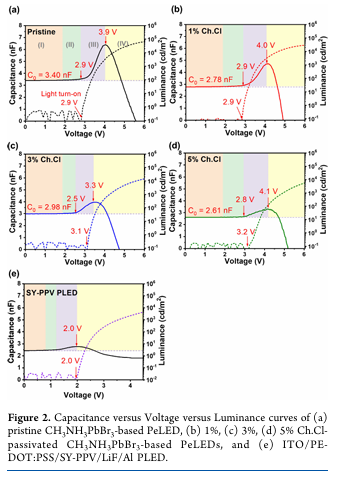
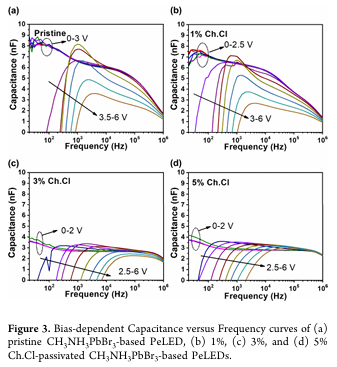
Researchers at National Cheng Kung University in Taiwan, led by Tzung-Fang Guo, employed admittance spectroscopy to investigate the trapped states, interface dynamics, and carrier dynamics of CH₃NH₃PbBr₃-based perovskite light-emitting diodes (LEDs), exploring how choline chloride defect passivation improves interfacial carrier dynamics. This technique enables the investigation of the device's electrical behavior, revealing how trapped states influence capacitance, carrier injection, and recombination processes—crucial for improving device efficiency and stability. The study demonstrates that effective defect passivation significantly suppresses nonradiative recombination, mitigates ion migration, and ensures a more balanced charge injection and transport. To analyze these effects, voltage-dependent capacitance, luminance-capacitance-voltage relationships, and frequency-dependent capacitance were derived and evaluated. These analyses show that passivated devices exhibit reduced trap density, suppressed ion polarization, and enhanced radiative recombination, thus confirming the improvement in interfacial carrier dynamics. Compared to previous studies that primarily focused on device performance trends and supplementary electrical characterization, this paper focuses on a diagnostic analysis process based on admittance spectroscopy. The analysis was extended to frequency-resolved response functions and bias region mappings, and the electron trap response was clearly distinguished from the slower ion contribution, thus providing a more mechanistic explanation for charge accumulation, recombination, and stability.