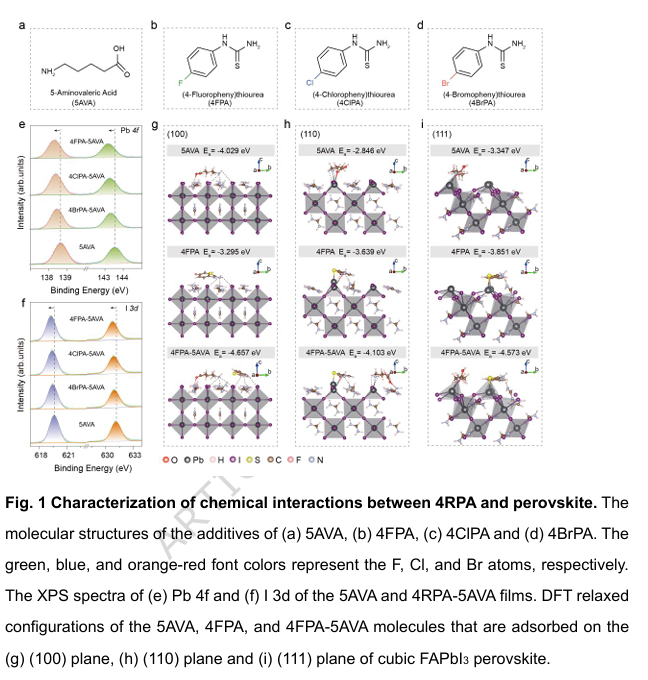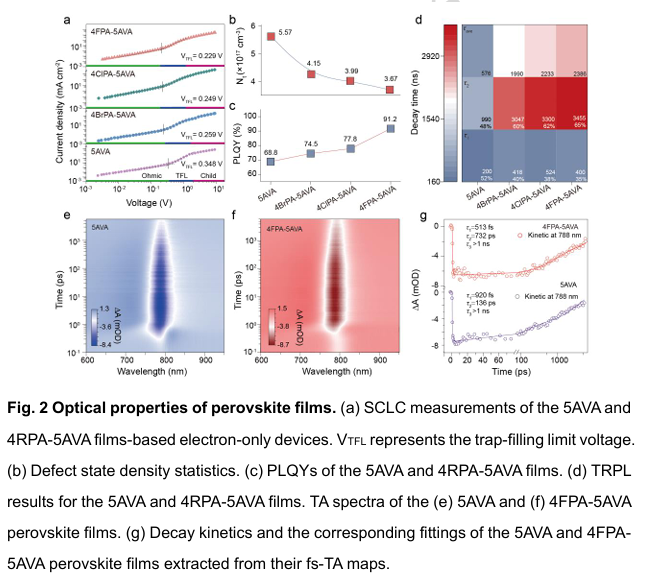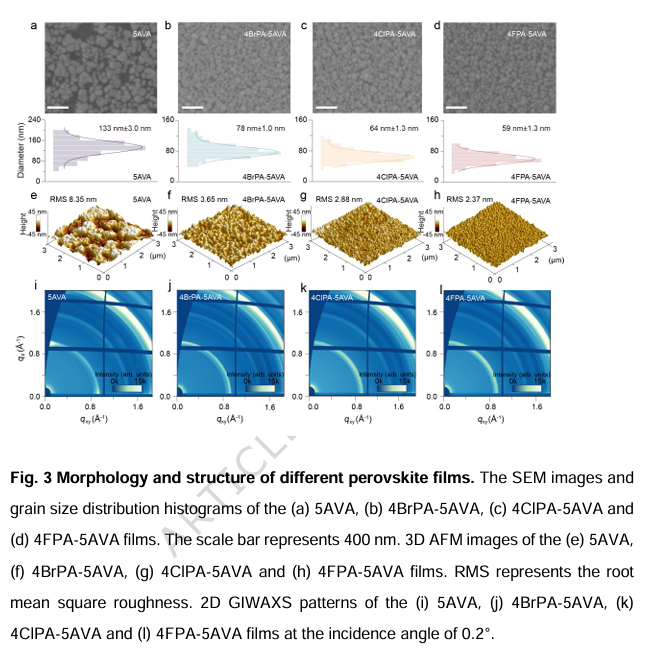

Introduction: Zhi-Kuang Tan from the National University of Singapore, and Bai Xue and Lu Min from Jilin University, among others, proposed a synergistic chelation method using two molecular additives—5-aminovaleric acid and (4-halophenyl)thiourea—to target and passivate multiple defect sites on different lattice planes of FAPbI₃ perovskite. The strong chelation effect on multiple crystal planes further promotes the isotropic and uniform growth of the FAPbI₃ perovskite film, thereby increasing the PLQY from 69% to 91%. The resulting near-infrared PeLEDs exhibit a high EQE of 26.3% and 1843 W·sr⁻².
Near-infrared light-emitting diodes play a crucial role in optical communication, medical imaging, and sensors, driving the development of various cutting-edge technologies. Three-dimensional FAPbI₃ perovskite, due to its high charge mobility and low quantum efficiency roll-off, has become a promising semiconductor for developing high-efficiency and bright near-infrared LEDs. However, lattice defects in FAPbI₃ generated during thin film processing lead to nonradiative losses and lower photoluminescence quantum yields, thus reducing the efficiency and radiant brightness of perovskite light-emitting diodes (LEDs).
Introducing additives into the FAPbI₃ perovskite fabrication process has been an important strategy for achieving thin films with lower defects and improving film morphology. To date, many additive molecules have been reported to improve the device performance of FAPbI₃ PeLEDs through defect passivation, thin film growth control, and reduction of Auger recombination. In a recent study, researchers investigated the chelating interactions between specific lattice faces on FAPbI₃ and single additives (such as phenylethylamine or 4-(2-aminoethyl)benzenesulfonamide). PEA molecules exhibited the strongest adsorption energy on the (100) facet but a weaker passivation effect on the (110) facet. In contrast, AEBS molecules, which possess both sulfonamide and amino functional groups, exhibited the highest Ea on the (110) facet. These results suggest that a single additive may be insufficient to passivate defects present on multiple lattice faces. Zhi-Kuang Tan from the National University of Singapore, and Bai Xue and Lu Min from Jilin University, among others, proposed a synergistic chelation method using two molecular additives—5-aminovaleric acid and (4-halophenyl)thiourea—to target and passivate multiple defect sites on different lattice planes in FAPbI₃ perovskites. The strong chelation effect on multiple crystal planes further promotes the isotropic and uniform growth of the FAPbI₃ perovskite film, thereby increasing the PLQY from 69% to 91%. The resulting near-infrared PeLEDs exhibit a high EQE of 26.3% and a high radiance of 1843 W·sr⁻¹·m⁻².