Driven by both generative AI (Gen AI) and global digital transformation, the massive demand for computing power is fundamentally changing the construction and operation models of data centers, especially with hyperscale data centers becoming the main focus of investment and construction.
TrendForce observes that lighting systems, which previously accounted for less than 2% of the total cost of data center construction, have now risen from a neglected aspect to an indispensable key component in achieving green and low-carbon goals, under stringent PUE (Power Usage Effectiveness) regulations and the trend towards zero carbon emissions. For example, the PUE of newly built data centers is strictly limited to below 1.3 or 1.4.
Data Center Lighting
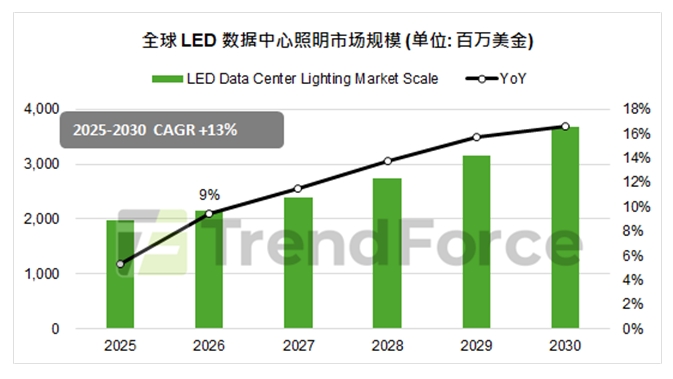
The data center lighting market is experiencing strong growth momentum, driven by the expansion of AI computing power and the increasing penetration rate of LED lighting. According to the latest data from TrendForce, the global LED data center lighting market reached US$1.97 billion in 2025 and is projected to further expand to US$2.16 billion in 2026, representing an annual growth rate of 9%. By 2030, the market size is expected to grow to US$3.69 billion, with a compound annual growth rate (CAGR) of 13% from 2025 to 2030.
Regionally, North America remains the world's largest market, benefiting from massive replacement and system upgrade demands. Meanwhile, the Asia-Pacific region, driven by policy guidance and digital economy investments in China, India, and Southeast Asia, is entering a new construction boom, becoming the region with the most prominent growth momentum.
Data center critical facilities require 24/7 uninterrupted operation, placing far higher demands on lighting reliability than general commercial lighting. To meet extreme energy efficiency requirements, mainstream LED lighting fixtures have generally achieved luminous efficacy exceeding 160 lm/W to effectively reduce the pressure on cooling systems from lighting heat loads. They also need a lifespan exceeding 100,000 hours and employ 4000K-5000K cool white light and high color rendering index for easy cable identification. Furthermore, with the increasing prevalence of "unmanned data centers," smart lighting fixtures supporting infrared or microwave sensing dimming have become standard, and on-demand lighting is rapidly penetrating the market.
Faced with this enormous market opportunity, the global data center lighting industry has formed a multi-tiered competitive landscape. For example, Signify, through its Cooper Lighting and Interact IoT platforms, provides full lifecycle services covering LiFi wireless technology and customized design, solidifying its high-end ecosystem market position. Acuity Brands, leveraging its robust edge computing strategy, has deeply integrated lighting into its building management system architecture, establishing its industry position in the North American market. Zumtobel, with its TECTON continuous cable tray system at its core, emphasizes high modularity, tool-free installation, and superior light quality, making it popular among high-end hosting and image-oriented data centers. LEDVANCE focuses on providing universal replacement solutions with standardized linear luminaires. PacLights specializes in high-ROI retrofits in the existing market, meeting low-cost maintenance needs with magnetic kits and flexible dimming designs.
TrendForce believes that data center lighting systems are increasingly integrated into the overall infrastructure architecture. In the future, leading manufacturers with cross-system integration capabilities and EPD (Enhanced Product Development) certification will continue to expand their influence in the high-end market; while manufacturers focusing on existing system retrofits and providing flexible retrofit solutions will also maintain a strong foothold, making market specialization increasingly clear.
