
Colloidal quantum dots have attracted significant attention from academia and industry due to their tunable emission wavelength, high color purity, solution processability, and excellent luminous efficiency. As an emerging electroluminescence technology based on quantum dots, quantum dot light-emitting diodes (LEDs) have become important candidates for future display technologies. In recent years, through innovations in structural design, quantum dot synthesis, interface optimization, and fabrication processes, device performance has been significantly improved. Currently, the external quantum efficiency of red and green light devices generally exceeds 25%, while the performance of blue light devices remains relatively lagging, with pure blue light devices being particularly prominent. Pure blue light devices with narrow emission linewidth, high efficiency, and high brightness are necessary prerequisites for realizing full-color ultra-high-definition displays. However, currently reported high-efficiency blue light devices are mostly concentrated in the sky blue light band, which limits the color gamut and hinders the development of wide color gamut ultra-high-definition displays. Therefore, it is urgent to improve the performance of blue light devices, especially pure blue light emitting devices.
Existing strategies for improving the performance of blue light devices mainly include quantum dot surface chemical modification and charge transport layer engineering. The former improves energy level alignment and carrier mobility by optimizing the surface chemistry of quantum dots: for example, propanethiol-modified quantum dots promote charge transport and injection balance through short-chain ligands, achieving high-efficiency blue light devices. The latter achieves more balanced carrier injection by modulating the charge transport layer: for example, constructing one-dimensional transport channels in a cross-linked hole transport layer to enhance hole transport, or using tin-doped zinc oxide to replace the zinc oxide electron transport layer to suppress electron over-injection. In addition, insulating polymers and other materials are often used as interface layers between the electron transport layer and quantum dots to alleviate electron over-injection. Compared to electron transport layer and interface layer engineering, which mainly improves charge balance by suppressing electron injection, hole transport/injection layer engineering typically achieves charge balance by enhancing hole injection, and is more likely to simultaneously improve device brightness and efficiency.
Existing research mostly focuses on single functional layer modification, making it difficult to achieve high brightness and high efficiency simultaneously. Synergistic modulation of functional layers is expected to overcome current limitations and provide a new technological path for high-performance blue light devices.
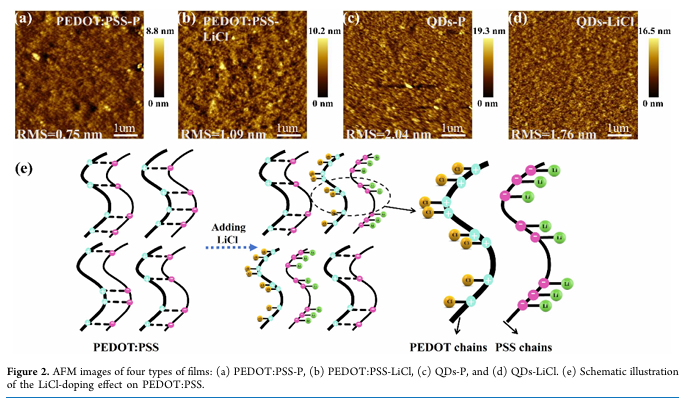
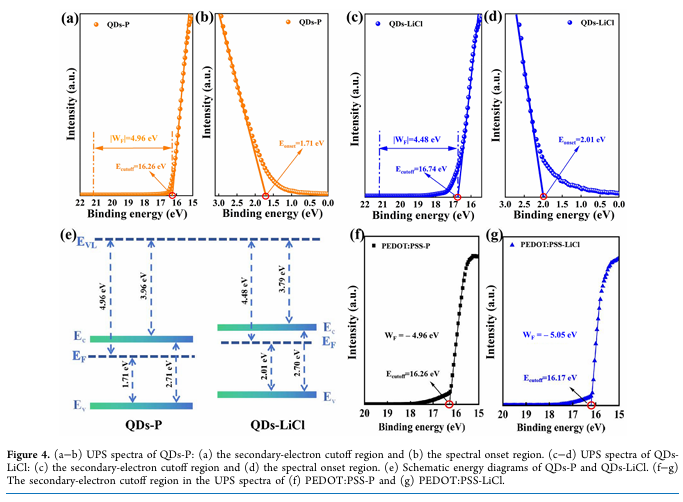
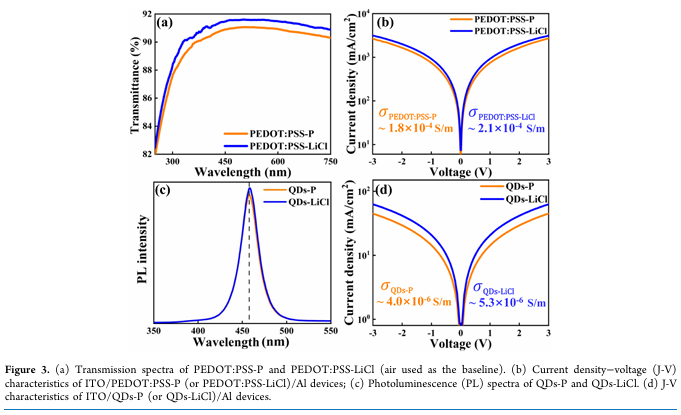
A team led by Zhai Guangmei at Taiyuan University of Technology developed a simple and effective dual-target lithium chloride treatment strategy to improve the performance of pure blue light-emitting devices by simultaneously modifying the quantum dot emitting layer and hole injection layer. This strategy not only optimizes the surface chemistry of the quantum dots and their energy level matching with the transport layer, reducing interfacial fluorescence quenching, but also enhances the conductivity, transmittance, and hole injection efficiency of the hole injection layer. The treated pure blue light device achieved a peak wavelength of 461 nm, an emission linewidth of 19 nm, a maximum luminance of 27210 cd/m², a maximum power efficiency of 8.83 lm/W, a maximum current efficiency of 10.10 cd/A, and a peak external quantum efficiency of 23.44%, significantly outperforming untreated and single-target treated devices. This work demonstrates the effectiveness of synergistic modification of functional layers in improving device performance and provides a feasible path for fabricating high-performance pure blue light-emitting devices.