

The 2023 Nobel Prize in Chemistry was awarded for the discovery and development of quantum dots. The Nobel Committee stated, "Quantum dots are bringing the greatest benefits to mankind, and our exploration of their potential has only just begun." This award not only represents the highest recognition of quantum dot research but also highlights its enormous potential in fields such as display lighting, energy catalysis, biomedicine, and quantum technology. This special report focuses on silicon quantum dots, particularly solvent-dispersed systems, systematically introducing research progress in synthesis methods, structural properties, and optical properties, as well as its application in solution-processed light-emitting diodes (LEDs).
Quantum dots are semiconductor nanocrystals with dimensions of only a few nanometers. Colloidal quantum dots possess several unique advantages: size-tunable full-color emission can be achieved through non-vacuum processes; their photoluminescence quantum yield can approach 100%; they have a narrow emission bandwidth of 20-40 nm, with a color gamut three to four times that of organic light-emitting diodes; and they can be prepared at room temperature using low-temperature solution methods. Thanks to these characteristics, core-shell structures with narrow-bandgap engineering control have been realized, and commercial products such as quantum dot televisions have been successfully developed. Looking ahead, quantum dots are expected to play a central role in the development of miniature LEDs, micron-sized LEDs, and quantum dot LED technologies, and drive the development of next-generation technologies for human-centered optoelectronics, such as stretchable wearable devices. Driven by this technological wave, the global quantum dot market is projected to continue expanding at a CAGR of 9.47%.
However, the widespread application of quantum dot technology still faces three major challenges: First, the availability of raw materials is difficult and may pose safety risks. Currently, commercially available quantum dots are mostly based on heavy metal materials, such as the rare metal indium and toxic metals cadmium and lead. In contrast, colloidal silicon quantum dots and their nanomaterials are inherently free of heavy metals and halogens, providing an ideal alternative for sustainable next-generation displays, solid-state lighting, biomedical imaging, and even cutting-edge quantum fields. Second, the efficiency bottleneck of quantum dots urgently needs to be overcome. Although cadmium-based and perovskite quantum dots have achieved near 100% quantum yield, heavy metal-free systems have long lagged behind due to surface defects and incomplete passivation. Encouragingly, recent research has increased the quantum yield of silicon quantum dots to over 70%. Third, existing synthesis methods urgently need simplification. The widely used hot-injection method requires rapidly injecting the precursor into a high-temperature solvent to trigger nucleation, placing stringent demands on temperature control, inert atmosphere, and specialized equipment, resulting in high costs for large-scale production. More importantly, there is currently no suitable precursor or solvent that can synthesize silicon quantum dots with both high crystallinity and excellent optical properties using the hot-injection method.
Over the past two decades, the research team has systematically advanced several milestones in silicon quantum dot research: achieving tri-color emission and continuous white light emission; developing the first sky-blue emitting silicon quantum dot diode; developing a low-cost synthesis route that reduces production costs by hundreds to thousands of times; preparing sustainable silicon quantum dot diodes using rice husks; obtaining silicon quantum dots with a quantum yield of approximately 80% and well-defined crystallinity; fabricating durable red, green, and blue tri-color thin films; achieving light-emitting diode devices with an external quantum efficiency exceeding 10%; and setting four performance records.
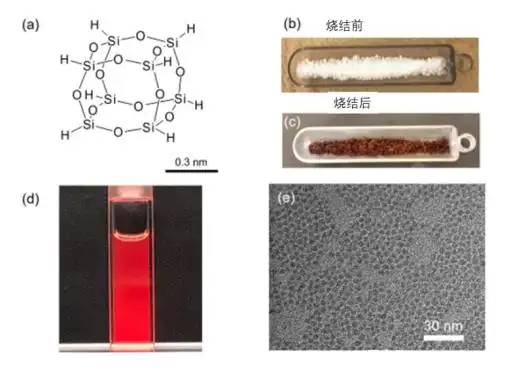
Ken-ichi Saitow et al. from Hiroshima University, Japan, summarized the synthesis methods, structural characteristics, and photophysical properties of highly crystalline silicon quantum dots with a quantum yield as high as 80% in a special report. After outlining the advantages of silicon quantum dots, the focus shifts to the synthetic route of colloidal silicon quantum dots, particularly the hydrogen silsesquioxane polymer method. This method eliminates the need for a hot injection step and can be carried out under mild room temperature conditions, avoiding the requirements of rapid precursor injection and stringent operating procedures. This significantly simplifies the experimental process and facilitates large-scale production. Hydrogen silsesquioxane-derived materials prepared based on this synthetic route further demonstrate the record-breaking achievements in silicon quantum dot light-emitting diodes across four key performance indicators.
